




Estimated reading time: 8 minutes.
Table of contents
- Architecture and philosophy
- Distributed ownership
- Trustless infrastructure
- Resilience through redundancy
- Governance and incentives
- Where centralization still works
- Independent foundations and usable interfaces
Architecture and philosophy
Decentralization is often described as the absence of a center, but that definition is incomplete. Most decentralized systems still contain influential nodes, maintainers, service providers, and institutions. The more useful distinction is that no single participant should be able to control the entire system by default. Authority, data, verification, or operation is distributed far enough that the network can continue when one company, server, or governing body becomes unavailable or untrustworthy.
That makes decentralization both a technical architecture and a philosophical movement. Technically, it asks how a system behaves when coordination occurs across independent machines and organizations. Philosophically, it asks who is allowed to participate, who can change the rules, and whether users can continue operating without permission from a central gatekeeper. The architecture determines more than uptime. It determines where power accumulates.
Centralized systems remain attractive because they are efficient. One organization can make decisions, deploy upgrades, resolve disputes, recover accounts, and optimize infrastructure around a coherent plan. The same concentration creates fragility. A central operator can be attacked, corrupted, censored, acquired, compelled, or simply shut down. A system with one source of authority also has one place where authority can fail.
"Every architecture decides where power accumulates, even when that decision is hidden behind convenience."
Decentralized systems trade some of that convenience for independence. They accept harder coordination, duplicated work, and less predictable governance in exchange for reducing the number of events that can end the system completely. The trade is not automatically worthwhile. It depends on whether the system values speed and control more than resilience and participant autonomy.
Distributed Ownership
Ownership in a digital system has several layers. One organization may own the servers, another may define the protocol, and users may still retain control of their identities or data. Decentralization spreads some combination of those responsibilities across many participants. The result is not necessarily equal ownership, but a structure in which control is harder to exercise unilaterally.
Open protocols illustrate this clearly. The web and email are useful partly because no single company owns the entire communication layer. Organizations can operate servers independently while following shared rules. Federated social platforms apply a similar model: communities run separate services, establish local moderation policies, and communicate through a common protocol. Peer-to-peer networks go further by allowing participants to exchange data directly instead of routing every interaction through one provider.
This distribution gives users and communities room to participate without depending entirely on a central gatekeeper. A provider can disappear while the protocol survives. A community can move to a different host without abandoning the larger network. Developers can build compatible tools without waiting for one company to expose an approved interface.
The hurdle is coordination. Shared ownership means shared disagreement. Protocol upgrades must account for multiple implementations. Governance decisions can fragment communities. Disputes may have no obvious authority capable of producing a final answer. Centralized systems can resolve ambiguity through command; decentralized systems often have to resolve it through consensus, compatibility, or separation.
Trustless Infrastructure
The word "trustless" is easy to misunderstand. It does not mean that trust disappears. Every system depends on assumptions about software, hardware, maintainers, cryptographic primitives, and human behavior. Trustless infrastructure reduces the need to place complete trust in a single person or institution. It replaces private assurances with rules that can be verified by more than one participant.
Cryptographic signatures can prove that an artifact came from a particular key. Transparent protocols can let independent implementations inspect the same messages. Shared verification can allow many nodes to reject invalid state transitions. A blockchain is one example: participants maintain a replicated record and use a consensus process to decide which updates are accepted. The broader idea also appears in signed software releases, certificate transparency, reproducible builds, and peer-verified data exchange.
The benefit is resistance to hidden manipulation. When rules are public and validation is shared, one operator has less freedom to rewrite history, censor a participant, or change behavior without detection. Trust moves away from institutional reputation and toward mechanisms that participants can inspect or verify.
That shift creates a difficult consequence: protocol enforcement is often less forgiving than institutional judgment. A conventional service can reverse a mistaken transaction, reset a credential, or restore a deleted account. A decentralized protocol may have no support desk and no privileged reversal mechanism. If a private key is lost, a malicious instruction is signed, or data is published permanently, the system may behave exactly as designed while producing an outcome the user never intended.
Resilience Through Redundancy
Decentralized networks become resilient by refusing to depend on one copy, one route, or one operator. Data may be replicated across nodes. Requests may travel through different peers. Multiple implementations may speak the same protocol. When an individual machine fails, the network can continue because another participant still holds the data or can perform the work.
Peer-to-peer file distribution demonstrates the basic pattern. A file does not need to remain available from one origin server when many peers can provide pieces of it. Distributed storage extends the idea by spreading durable copies across independent machines or regions. Community-run network infrastructure can keep local services operating even when a commercial provider withdraws. Open protocols allow replacement software to appear when an existing client or host disappears.
The benefit is not perfect uptime. Decentralized systems can still fail through bugs, coordinated attacks, economic collapse, or widespread network disruption. Their advantage is graceful degradation. Individual nodes can leave without taking the whole network with them. Blocking one endpoint does not necessarily block every path. Acquiring one company does not automatically transfer ownership of the underlying protocol.
This makes decentralized infrastructure harder to destroy, censor, or monopolize, but the redundancy is not free. Replicated data consumes more storage. Shared verification consumes bandwidth and computation. Consensus adds latency. Globally distributed state is harder to keep synchronized than a database inside one controlled environment. Some blockchain networks demonstrate the extreme version of this cost, where security mechanisms can require substantial energy or limit transaction throughput.
Governance And Incentives
Architecture alone cannot produce decentralization. A network may distribute its servers while leaving protocol changes in the hands of a small team. It may allow public voting while giving most influence to a few wealthy participants. It may publish source code while relying on infrastructure controlled by one cloud provider. The visible topology can be distributed while practical authority remains concentrated.
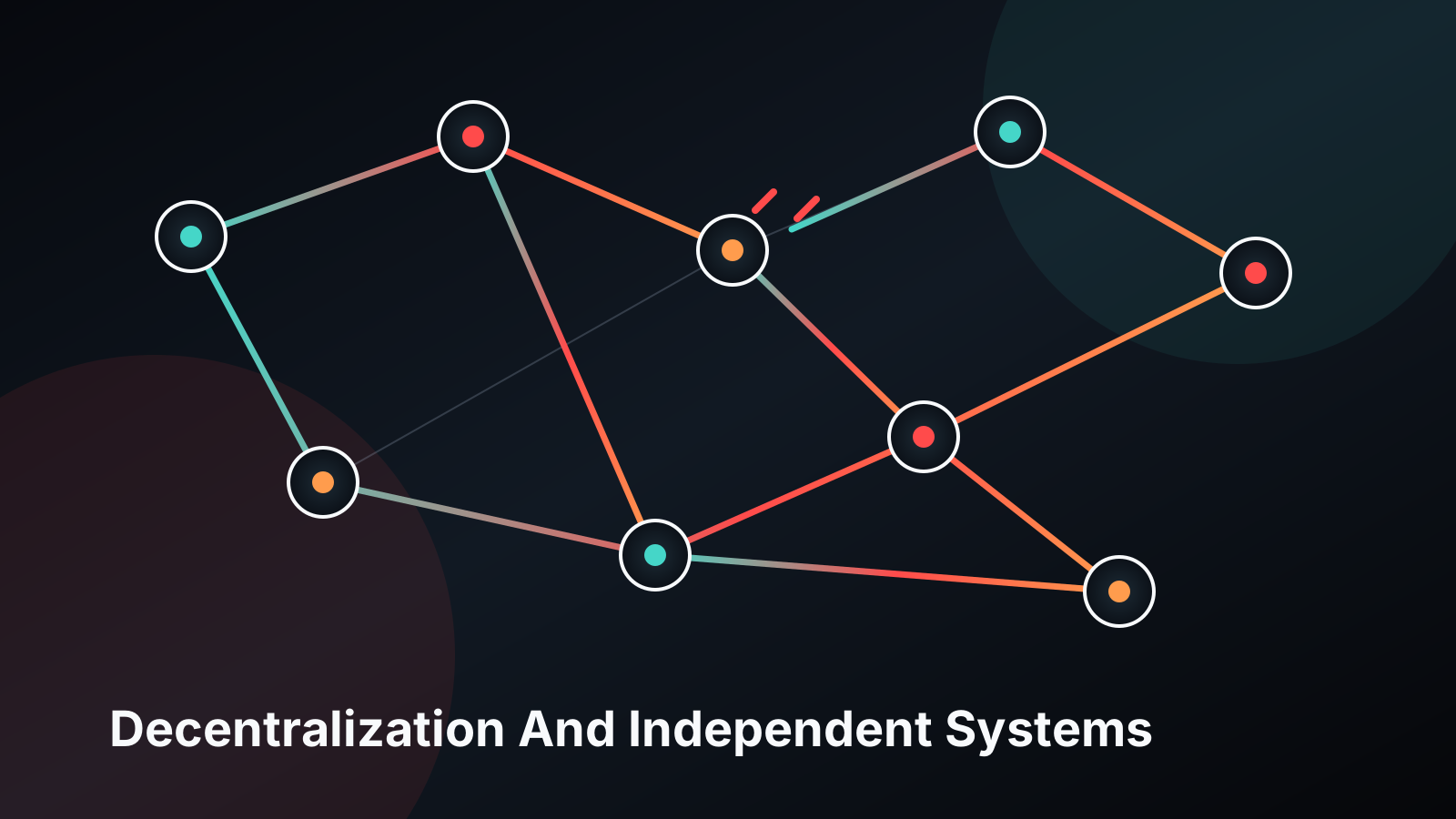
"A system is not decentralized merely because its diagram contains many nodes."
Durable decentralization depends on incentives. Participants need reasons to contribute storage, bandwidth, moderation, software maintenance, or governance work. Abuse must be expensive enough to discourage spam and manipulation. Useful behavior must remain worthwhile even when participants do not share the same values or objectives.
When incentives align, communities can govern shared infrastructure directly. Contributors maintain protocols, local operators establish policy, and independent organizations fund work that benefits the broader network.
Poor incentives produce different outcomes. Voting power can become plutocratic. Low participation can let organized minorities control governance. Rewards can attract automated spam rather than useful contribution. Informal influence can accumulate among maintainers who possess the time, reputation, or technical knowledge required to shape decisions. Control has not disappeared in those cases; it has moved into a structure that may be harder to see.
Governance must therefore be evaluated by outcomes, not labels. Who can propose a change? Who can reject it? Who bears the cost of failure? Can dissatisfied participants leave with their identity and data, or are they decentralized in name while remaining locked into one ecosystem? These questions reveal whether shared control is real.
Where Centralization Still Works
Decentralization is not automatically better. Some systems benefit from having a clear operator with the authority to act quickly. Emergency response, account recovery, fraud investigation, tightly regulated data, and high-performance transactional workloads may require decisions that cannot wait for broad consensus. Users often want an identifiable organization to be accountable when something goes wrong.
The risk is confusing operational simplicity with permanent legitimacy. A central operator that behaves responsibly today may change ownership, incentives, or policies tomorrow. The design question is not whether the current institution is trustworthy. It is how much damage becomes possible if that trust stops being deserved.
For many products, centralization remains the simplest correct choice. The important work is to identify which powers truly need to be centralized and which dependencies can remain portable, inspectable, or independently recoverable.
Independent Foundations And Usable Interfaces
The future will not be fully centralized or fully decentralized. Pure versions of either model solve the wrong problem for many users. People want fast interfaces, reliable search, account recovery, moderation, and support. They also benefit from portable identity, open protocols, replicated data, and the ability to leave a provider without losing access to the broader system.
The strongest architectures will likely separate those concerns. A company may operate a polished centralized interface over an open protocol. A service may cache and index distributed data without becoming its sole owner. A community may delegate routine operation to trusted maintainers while preserving transparent rules and credible exit paths. Centralized components can provide usability while decentralized foundations provide durability.
Decentralization is best understood as a design choice about dependence. Some systems should be centralized because speed, accountability, and simplicity matter most. Other systems benefit from decentralization because independence, censorship resistance, and long-term resilience are more important than operational neatness.
The durable future is likely to combine both. Centralized interfaces can make systems understandable and humane. Decentralized foundations can make them harder to erase, capture, or outlive. Usability and durability do not need to come from the same architectural layer, and the systems that recognize that distinction may prove stronger than those built around either extreme.