




Estimated reading time: 14 minutes.
Table of contents
- The venture and the question
- Why Harvey was a credible founder-market fit
- The wedge: expensive work with review already built in
- What the traction proves and what it does not
- The economic case
- The real product is a trust system
- Where the moat can come from
- A realistic founder-led launch plan
- Failure modes that can kill the venture
- Feasibility verdict
- Sources and evidence notes
The venture and the question
Harvey is a useful case study because it is not merely an AI feature attached to an existing software company. It is a founder-led attempt to build a new enterprise platform around a narrow professional domain: legal work. Attorney Winston Weinberg and AI researcher Gabe Pereyra founded the company in 2022, combining direct knowledge of legal workflows with experience building large language models. That pairing matters. Vertical AI companies need to understand both what the model can do and what the customer is professionally allowed to trust it to do.
The company’s growth makes the case worth examining. Harvey reported more than 500 customers, over $100 million in annual recurring revenue, and 350 employees by August 2025. It later reported surpassing 1,000 customers in 60 countries. Those figures are company-reported rather than audited public-company disclosures, but they establish more than investor excitement: sophisticated buyers repeatedly paid for a legal-specific AI product and expanded its use.
The important entrepreneurial question is not, “Can another founder build another Harvey?” Harvey’s capital, partnerships, enterprise access, and timing cannot be copied. The better question is:
What does Harvey reveal about when a founder-led vertical AI venture is actually feasible?
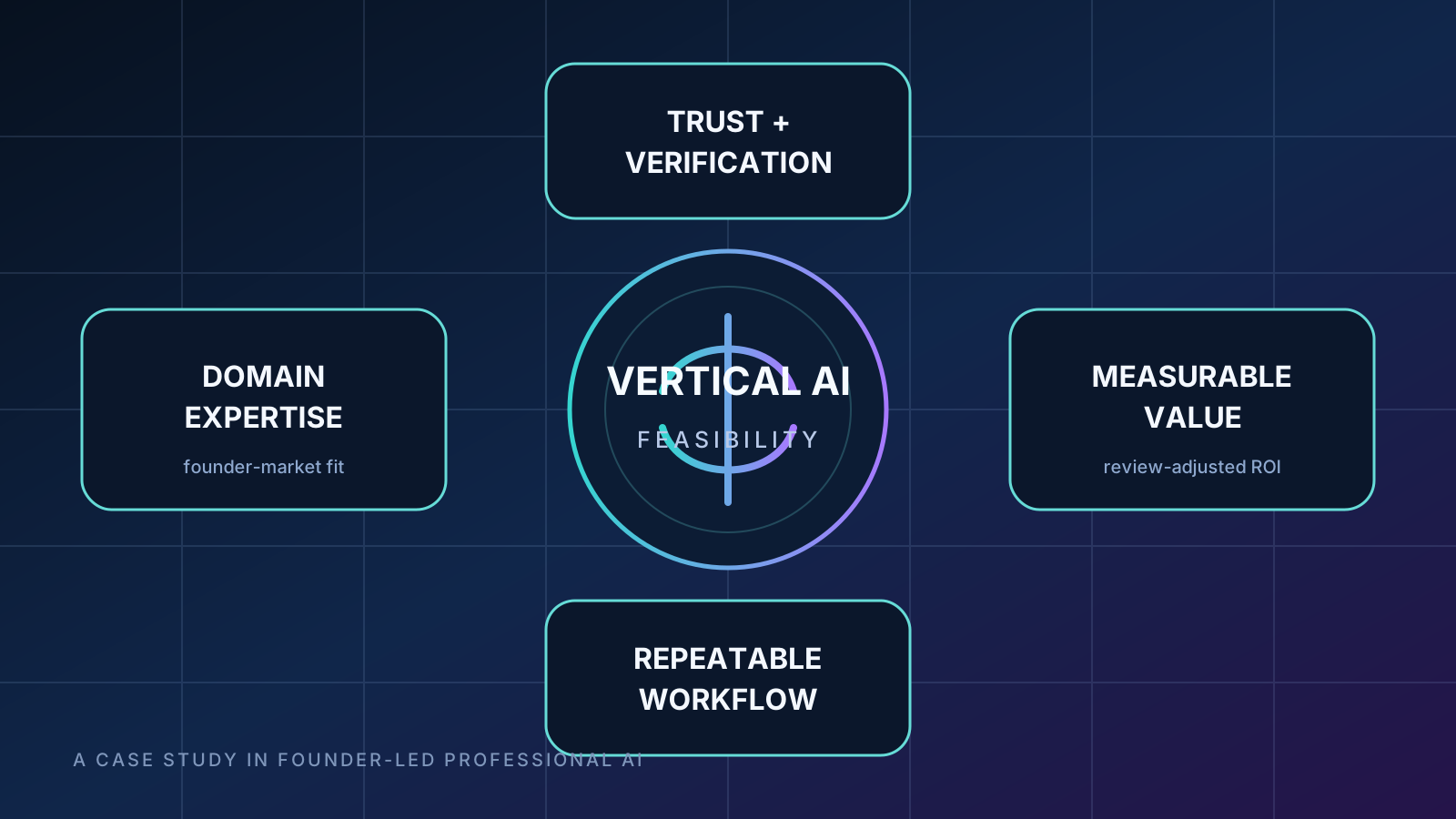
My conclusion is conditional. A vertical AI venture is feasible when it enters through a painful, high-value workflow; keeps a qualified human responsible for the decision; produces evidence that makes its work reviewable; and turns domain-specific trust into distribution and retention. It is not feasible merely because a general model can produce an impressive demonstration.
Why Harvey was a credible founder-market fit
Harvey began with an unusually complementary founding team. Weinberg had worked in antitrust and securities litigation. Pereyra had worked on large language models at Google Brain and Meta. One founder could identify where legal work becomes slow, repetitive, and costly. The other could distinguish a model limitation from a product-design problem.
That is more than a biographical advantage. It reduces four early-stage risks:
- Problem risk. Domain experience helps identify work customers urgently want improved, rather than work that merely looks automatable from outside the profession.
- Evaluation risk. A domain expert can define what a good answer looks like, including the omissions and subtle errors a generic benchmark misses.
- Workflow risk. The team can see where review, approval, access control, and citation must fit into the customer’s actual process.
- Credibility risk. Regulated professionals are more likely to engage when the founders understand their obligations and language.
Harvey’s first validation was deliberately small. According to an OpenAI case study, the founders generated answers to 100 landlord-tenant questions and asked attorneys to assess them; the attorneys said 86 could have been sent to clients without editing. That was not proof of a safe production system. It was evidence that model output had crossed a threshold of professional usefulness under human review.
This is a replicable lesson. The first experiment did not require a complete platform, autonomous agent, or nationwide legal corpus. It tested one risky assumption: whether qualified users found the output valuable enough to continue the conversation.
The wedge: expensive work with review already built in
Legal work has several traits that make it attractive for vertical AI:
- Professionals spend substantial time reading, comparing, extracting, researching, and drafting text.
- The economic value of an hour is high.
- Firms already use review hierarchies, so AI output can enter as a draft rather than a final decision.
- Work is document-rich and leaves artifacts that can support evaluation.
- Errors are costly, which makes trustworthy workflow design valuable instead of optional.
Harvey did not need to replace an attorney to create value. It needed to shorten the distance between a large body of material and a reviewable first analysis. Its reported use cases include contract comparison, litigation research, due diligence, document drafting, and extracting structured information from large collections.
That distinction is fundamental to feasibility. A venture that sells “an AI lawyer” inherits the broadest possible liability, accuracy, and adoption problem. A venture that sells “a faster, sourced first pass through 2,000 contracts, reviewed by counsel” defines an outcome that can be tested and supervised.
The customer remains accountable. The machine compresses the search space.
The American Bar Association’s Formal Opinion 512 reinforces this boundary. Lawyers using generative AI still have duties involving competence, confidentiality, communication, supervision, candor, and reasonable fees. For an entrepreneur, regulation is not only a constraint; it is a product specification. The system must help the professional satisfy those duties rather than ask the professional to work around the product.
What the traction proves and what it does not
Harvey reported that it grew from 40 customers to 235 customers in 42 countries during 2024 while annual recurring revenue increased fourfold. In August 2025 it reported more than $100 million ARR, more than 500 customers, and fourfold year-over-year growth in weekly active users. These numbers suggest three things.
First, legal AI can support a real enterprise budget. Second, adoption can expand after the novelty phase, because usage and stored files grew alongside customer count. Third, a vertical layer can retain value even as general foundation models improve.
The evidence still has limits. The company does not publicly disclose gross margin, net revenue retention, customer acquisition cost, contract length, inference cost per workflow, or the concentration of revenue among its largest firms. Funding valuations are investor judgments, not operating results. Customer counts do not tell us whether every deployment is profitable or deeply adopted.
A responsible case study should therefore treat Harvey as proof of demand, not proof that every vertical AI model has attractive economics.
There is also survivor bias. Harvey entered when GPT-3 and GPT-4 created a sharp capability shift, won early support from OpenAI, and gained access to major law firms. Hundreds of less visible AI products launched into the same wave without acquiring durable distribution. The correct lesson is not that the market rewards any specialized wrapper. It is that timing, founder-market fit, enterprise trust, and product depth can turn a model capability into a company.
The economic case
The simplest feasibility model is based on customer value, not token cost.
Suppose a 50-lawyer firm saves only two hours per lawyer per week on work that remains professionally useful. At 48 working weeks, that is 4,800 hours of recovered capacity per year. The value is not automatically equal to 4,800 times a billing rate; some saved work would not have been billed, and fixed-fee or contingency practices capture efficiency differently. But the capacity can still reduce write-offs, absorb more matters, improve response time, or redirect lawyers toward higher-value judgment.
Harvey has published customer examples that make the mechanism concrete. In a December 2025 account, it said Repsol estimated four to six hours saved per lawyer per week, Deutsche Telekom estimated five, and a 40-seat Syngenta deployment estimated $320,000 saved over six months. These are vendor-selected and customer-reported examples, not controlled studies. They are useful as hypotheses for ROI, not universal performance guarantees.
For the vendor, the economic equation is:
Annual contract value − model and infrastructure usage − implementation and support − security and compliance cost − sales cost = contribution margin.
Early founders often focus on the first two terms because APIs make software appear cheap to deliver. Enterprise vertical AI makes the middle terms decisive. Customers may require data-processing agreements, security questionnaires, single sign-on, audit logs, permissions, data residency, model-provider disclosures, evaluation evidence, and hands-on workflow design. A product can have excellent model-level gross margin and still be a poor business if each customer needs months of founder support.
This suggests a disciplined pricing rule: price against verified workflow value while tracking the fully loaded cost of acquiring, implementing, serving, and renewing the account. Unlimited usage without workload controls can make inference cost unpredictable. Per-seat pricing can misalign with automated high-volume workflows. Pure consumption pricing can make customers afraid to explore. A hybrid model, with platform access plus governed usage tiers, is often the more testable starting point.
The real product is a trust system
In high-stakes vertical AI, the model is one component. The actual product is a trust system around the model.
Harvey describes source-linked answers, customer-controlled retention, encryption, role-based access, audit logs, regional processing, and contractual prohibitions on training with customer data. It says model providers operate with zero data retention and customer workspaces are logically separated. The company also says it invested early in SOC 2 Type II and ISO 27001 and built a security function that represents a meaningful share of engineering.
These claims are self-descriptions, and certifications do not guarantee that a system is invulnerable. They still reveal what enterprise customers purchase. A generic chat interface can demonstrate capability. A production platform must answer:
- Who can see each document and output?
- Can the answer be traced to authoritative material?
- What happens when a retrieved document contains a malicious instruction?
- Is customer data retained, reused, or sent to another provider?
- Can an administrator audit access and export or delete data?
- How is a model change evaluated before it reaches customers?
- What must a human approve before an action has an external effect?
The NIST Generative AI Profile identifies risks including confabulation, data privacy, information security, harmful bias, and human over-reliance. For a small venture, the answer is not to reproduce every control of a late-stage company on day one. It is to narrow the product’s authority until its controls are proportionate and honest.
An early product can process a limited document set, produce citations, avoid external actions, require explicit review, retain minimal data, and publish its limitations. It should not pretend that a prompt instructing users to “verify the answer” transfers the vendor’s responsibility for weak architecture.
Where the moat can come from
Model access alone is not a durable moat. Competitors can often call the same providers, and foundation models improve quickly. A vertical AI company must accumulate advantages above and around the model.
Workflow depth. The product should understand the sequence of real work: intake, permissions, source selection, analysis, revision, approval, export, and audit. Replacing isolated prompting with repeatable workflow reduces customer effort.
Evaluation infrastructure. A domain-specific test set, expert grading rubric, regression history, and failure taxonomy become more valuable with every model change. The venture learns which model or tool chain is reliable for each task instead of betting the company on one provider.
Customer configuration. Firm precedents, playbooks, clause libraries, approval rules, and saved workflows create legitimate switching costs when they remain portable and governed by the customer.
Distribution and trust. Deep relationships, credible security work, references, integrations, and successful procurement create an advantage that a technically similar newcomer cannot instantly copy.
Outcome data. The most defensible data is not a pile of confidential customer documents. It is permissioned feedback about whether outputs were accepted, corrected, rejected, or useful. That data can improve routing and evaluation without quietly converting client material into shared training data.
Harvey’s partnership with OpenAI also shows the benefit and risk of model-provider leverage. Custom training and early technical collaboration helped the product exceed a basic retrieval system. At the same time, any venture built on external models faces price changes, capability convergence, outages, policy changes, and the possibility that its supplier launches a competing feature. A credible architecture needs model abstraction where practical and a clear statement of which proprietary value remains if the underlying model becomes cheaper and better.
A realistic founder-led launch plan
Harvey’s current scale is not an appropriate starting blueprint. A capital-efficient founder should begin with a much smaller proof.
Phase 1: one workflow, one buyer, one measurable result
Interview 15 to 25 qualified users in one narrow segment. Select a repeated workflow with accessible source material, a painful baseline, and mandatory human review. Measure its current cycle time, error modes, and cost. Build a concierge prototype and run it on historical, permissioned examples.
The gate to continue is not model accuracy in isolation. At least five users should complete the workflow repeatedly, prefer the assisted process, and quantify a benefit they would pay to preserve.
Phase 2: a controlled pilot
Turn the prototype into a limited product for three to five design partners. Add tenant isolation, access controls, source citations, deletion, audit events, model and prompt versioning, and a human approval boundary. Define a task-specific evaluation set before changing models.
Charge for the pilot. A free pilot tests curiosity; a paid pilot tests budget and urgency. Track time to first value, weekly active use, task completion, correction rate, cost per completed workflow, support hours, and renewal intent.
Phase 3: repeatability before breadth
Standardize onboarding and prove that a customer can reach value without continuous founder intervention. Integrate with the system where the work already lives. Expand to an adjacent workflow only when the original one retains users and produces healthy contribution margin.
The decisive metric is not the number of generated words. It is the percentage of target workflows completed with acceptable review effort and an auditable outcome.
Phase 4: enterprise hardening
Only after repeatability should the company invest heavily in broad certifications, regional infrastructure, advanced administration, and a larger sales organization. Some regulated buyers will require these controls earlier; if so, the founder must either fund that path deliberately or begin with a segment whose procurement requirements fit the company’s stage.
Failure modes that can kill the venture
A demonstration without a workflow. Good answers attract attention, but customers pay repeatedly for completed work that fits their systems and responsibilities.
Unbounded scope. “AI for all legal work” prevents honest evaluation. Different tasks have different sources, risks, and definitions of correctness.
No review economics. An answer that takes longer to verify than to create has negative value, even if it sounds sophisticated. Citations, diffs, confidence signals, and structured output should reduce review time.
Security theater. A policy page cannot compensate for shared credentials, weak tenant isolation, excessive logging, or unclear subprocessors. In a confidential domain, one serious boundary failure can end the company.
Autonomy ahead of reliability. Allowing a model to file, send, purchase, or modify external records magnifies hallucination and prompt-injection risk. Read-only assistance and explicit approval are often the right early boundary.
Dependence disguised as a moat. A custom prompt on a single model provider is a feature. Durable value requires workflow, evaluation, trust, distribution, or proprietary product data.
Efficiency that attacks the buyer’s revenue model. Hourly firms may value capacity while also worrying that fewer billable hours reduce revenue. The product must connect efficiency to faster turnaround, higher realization, fixed-fee margin, better client experience, or greater matter capacity.
Enterprise sales before product learning. Large contracts can consume the roadmap. A founder may confuse one customer’s bespoke requirements with a repeatable market.
Feasibility verdict
Harvey demonstrates that founder-led vertical AI can become a substantial business. It does not demonstrate that the category is easy, cheap, or won by model access alone.
The opportunity is strongest when five conditions are present:
| Condition | Feasibility test |
|---|---|
| Expensive recurring work | The customer can quantify time, delay, error, or capacity cost. |
| Reviewable output | A qualified user can verify the result faster than producing it manually. |
| Domain access | The founders can reach users, examples, and expert evaluators. |
| Trust architecture | Confidentiality, permissions, provenance, retention, and approval are designed into the workflow. |
| Repeatable distribution | Similar customers share the problem and can adopt without bespoke engineering. |
For a new founder, I would rate the general vertical-AI thesis as feasible but highly conditional. The technical prototype is likely the easiest part. The hard company-building work is choosing a narrow problem, earning access to expert feedback, proving review-adjusted ROI, surviving procurement, and building a trust layer that improves as quickly as the models beneath it.
Harvey’s most valuable lesson is not its valuation. It is the sequence: complementary founders, a small domain-expert test, a high-value supervised wedge, deeper domain performance, enterprise trust, and then platform expansion.
That sequence is available to an entrepreneur even when Harvey’s capital is not.
Sources and evidence notes
- OpenAI: Customizing models for legal professionals: founding backgrounds, early 100-question validation, custom case-law model, and expert preference test.
- Harvey: Three Year Anniversary: company-reported August 2025 customers, ARR, usage growth, files, and headcount.
- Harvey: Series D announcement: company-reported 2024 customer and ARR growth.
- Harvey: How Our In-House Legal Team Uses Harvey: company-selected adoption and customer ROI examples.
- Harvey: Security by Design and Harvey Security: Harvey’s descriptions of its security organization, controls, data handling, and provider commitments.
- American Bar Association: Formal Opinion 512: professional duties implicated by lawyers’ use of generative AI.
- NIST: Generative AI Profile: cross-sector generative-AI risk-management guidance.
Unless otherwise stated, operating metrics in this article are reported by Harvey or its customers and have not been independently audited here. The feasibility conclusions and sample economics are my analysis, not claims made by the cited organizations.