




Estimated reading time: 11 minutes.
Table of contents
- The particle that completed a theory
- Why the Higgs boson had to exist
- How a particle is discovered without being seen
- The announcement on July 4, 2012
- What the discovery proved and what it did not
- What the Large Hadron Collider has done since
- What the collider is doing today
- The High-Luminosity LHC
- A discovery that became an instrument
The particle that completed a theory
On July 4, 2012, scientists at CERN announced that two independent experiments had found a new particle near 125 billion electronvolts. The result was not presented as the end of physics. It was announced with the careful language of experimental science: ATLAS and CMS had each observed a particle consistent with the long-sought Higgs boson, and each signal had reached the statistical threshold physicists call five sigma.
The announcement completed one of the longest searches in modern science. Nearly half a century earlier, theorists had described a mechanism that could explain why some elementary particles possess mass while the photon remains massless. The theory required an invisible field extending throughout the universe. If that field existed, it should sometimes reveal itself through a short-lived excitation: the Higgs boson.
The history is broader than one name. Robert Brout and François Englert developed the idea independently of Peter Higgs in 1964, and Gerald Guralnik, Carl Hagen, and Tom Kibble contributed a third paper later that year. The particle carries Higgs's name, while physicists often call the underlying theory the Brout-Englert-Higgs mechanism.
Finding the boson meant that an idea written in equations in 1964 had produced a measurable feature of nature. It also meant that the Standard Model of particle physics, already one of the most successful theories ever constructed, had survived another demanding test.
"The Higgs discovery did not finish the map of nature. It confirmed that one of its strangest landmarks was real."
The achievement is often reduced to the phrase "the particle that gives everything mass." That description is memorable but incomplete. The Higgs field gives mass to fundamental particles such as electrons, quarks, and the W and Z bosons through their interactions with the field. Most of the mass in familiar matter, however, comes from the energy of the strong interaction binding quarks and gluons inside protons and neutrons. The Higgs mechanism is essential, but it is not a universal substance that simply pours mass into every object.
Why the Higgs boson had to exist
The Standard Model describes matter through particles such as quarks and leptons and describes three fundamental interactions through force-carrying particles. Its equations work remarkably well, but a direct mass term for certain particles would break the symmetry that makes the theory mathematically consistent.
The Brout-Englert-Higgs mechanism provides a way through that problem. The Higgs field has a nonzero value even in otherwise empty space. Particles interact with this field at different strengths, and those interactions appear to us as different masses. The W and Z bosons interact strongly with it and become heavy. The photon does not couple to it and remains massless. Fermions such as electrons and quarks receive mass through related Yukawa interactions with the field.
The Higgs boson is evidence of the field in the same sense that a photon is evidence of the electromagnetic field. It is not the field itself. It is a detectable quantum disturbance in that field, produced only under extreme conditions and gone almost immediately after it appears.
This is why the Large Hadron Collider was necessary. The Higgs boson is too massive to appear in ordinary environments and too unstable to capture. Physicists needed to concentrate enormous energy into proton collisions, produce the particle rarely among billions of other events, and infer its presence from the particles into which it decayed.
How a particle is discovered without being seen
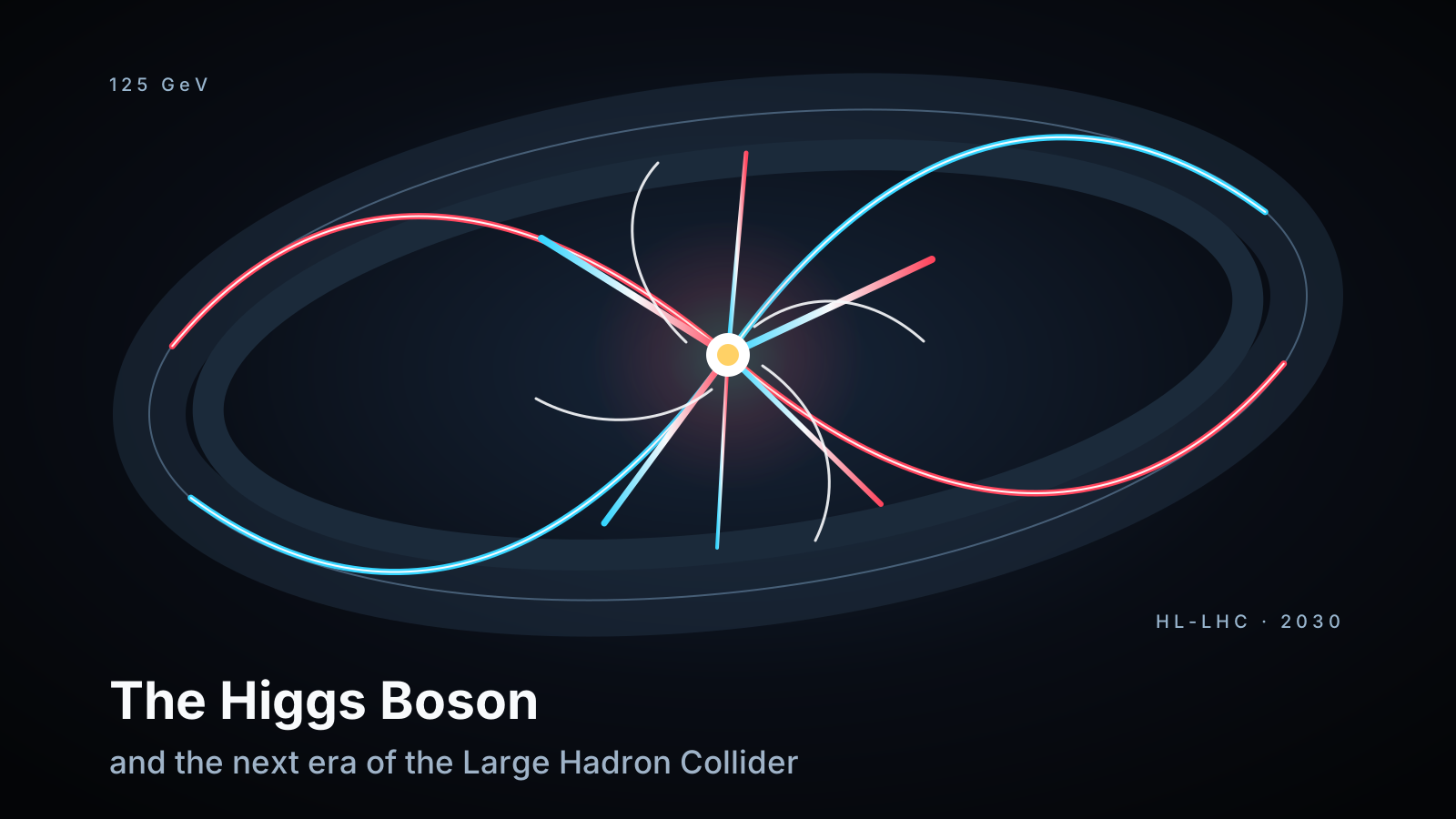
The Large Hadron Collider is a 27-kilometer ring of superconducting magnets beneath the French-Swiss border. It accelerates two beams of protons in opposite directions and brings them into collision inside large detectors. ATLAS and CMS were designed as independent, general-purpose experiments. They use different detector designs and separate analysis teams to study many of the same physical questions.
That independence was crucial to the Higgs discovery. Neither experiment photographed a tiny object moving through the detector. A Higgs boson survives for roughly 10⁻²² seconds before decaying. The detectors instead reconstructed it from the energy, momentum, and direction of its longer-lived decay products.
Researchers searched several decay channels. Two photons could leave a particularly clean energy signature. Four leptons produced through a pair of Z bosons, one of them virtual at this Higgs mass, created another precise channel. Decays involving W bosons added evidence through more complicated patterns in which neutrinos carried away energy without interacting with the detector. Each channel contained large backgrounds from ordinary Standard Model processes, so the task was statistical: determine whether an excess of events repeatedly appeared at the same mass.
It did. In the data collected during 2011 and the first part of 2012, both ATLAS and CMS found excesses near 125 to 126 GeV. Five sigma does not mean absolute certainty, but it corresponds to a chance of roughly one in 3.5 million that an excess at least this large would arise from a background fluctuation under the analysis assumptions. Two experiments using different instruments and analyses crossed the discovery threshold independently.
The announcement on July 4, 2012
The CERN auditorium was full before the seminar began. Peter Higgs, François Englert, and other scientists connected to the original theory were present as the collaborations presented their results. ATLAS reported clear signs of a new particle near 126 GeV. CMS reported a five-sigma signal near 125 GeV and confirmed that the new particle was a boson.
The caution in the announcement mattered. The experiments had discovered a new boson, but determining its identity required more than measuring its mass. A Standard Model Higgs must have no intrinsic quantum spin, must have positive parity, and must interact with other particles in specific ways. Those properties could only be established with additional data.
Over the following years, measurements confirmed that the particle behaved like the Higgs boson predicted by the Standard Model. Tests strongly favored the expected spin-zero, positive-parity assignment. Its interactions with W and Z bosons, top and bottom quarks, and tau leptons followed the expected pattern within improving experimental precision. In 2013, the Nobel Prize in Physics was awarded to François Englert and Peter Higgs for the theoretical discovery of the mechanism, developed with the late Robert Brout, that the experiments had now confirmed.
What the discovery proved and what it did not
The discovery confirmed that the Higgs field is part of nature and that electroweak symmetry breaking operates substantially as the Standard Model describes. It explained how the W and Z bosons can be massive while the photon is not, and it supplied the final elementary particle missing from the model.
It did not explain dark matter, dark energy, the imbalance between matter and antimatter, or why neutrinos have the masses they do. It did not unite gravity with quantum mechanics. It did not tell physicists why the Higgs field has its particular strength or why the Higgs boson has a mass near 125 GeV. The Standard Model contains parameters measured from nature rather than derived from a deeper principle, and the Higgs mass is one of them.
The particle may also be connected to the stability of the universe. The measured masses of the Higgs boson and top quark place our current vacuum near a boundary between absolute stability and a metastable state in Standard Model calculations. That does not imply an approaching catastrophe. It means that the properties of this particle are entangled with profound questions about why the universe has the structure it does.
The discovery therefore created an unusual situation. The Standard Model became more complete and more obviously incomplete at the same time.
What the Large Hadron Collider has done since
After the discovery, the LHC became a precision instrument for studying the Higgs boson. Run 2 raised proton collision energy to 13 TeV and produced much larger datasets. Run 3 began in 2022 at 13.6 TeV, the highest collision energy achieved in a laboratory, and continued through June 2026.
ATLAS and CMS have measured the Higgs boson's mass and interaction strengths with increasing precision. They have observed its production alongside top quarks and its decay into bottom quarks and tau leptons. Researchers are now searching for rare decays, possible invisible decays, and small deviations that could reveal particles or forces beyond the Standard Model.
The collider's work is much broader than Higgs physics. ALICE studies quark-gluon plasma, a state of matter associated with the early universe. LHCb makes exceptionally precise measurements of differences between matter and antimatter and has expanded the catalogue of composite particles. ATLAS and CMS test specific ideas such as supersymmetry and extra dimensions while also conducting broader searches for dark-matter candidates and unexpected collision signatures.
The absence of a dramatic new particle is scientifically meaningful. Each unsuccessful search excludes regions where proposed particles could have been hiding. Precision measurements can expose new physics indirectly, and strict experimental limits force theories to become more specific. Discovery is not the only way an experiment advances knowledge; ruling out plausible answers also changes the map.
What the collider is doing today
As of July 20, 2026, the LHC is not colliding particles. Its final Run 3 beams were dumped on June 27, and CERN has entered Long Shutdown 3. The phrase "shutdown" understates what is happening. Thousands of scientists, engineers, and technicians are carrying out a transformation expected to last roughly four years.
More than 1.2 kilometers of the collider will be dismantled and replaced with new systems. Teams are securing electrical circuits, opening accelerator sectors, and relocating computing equipment. The upgrade will add more powerful focusing magnets, superconducting "crab cavities" that better align the particle bunches, reinforced machine-protection systems, and new superconducting power links. The major experiments are also replacing detectors and electronics so they can operate in a far denser collision environment.
Data analysis does not stop when the beams stop. The experiments have years of Run 3 collision data to reconstruct, calibrate, and examine. New results will continue to emerge while the accelerator itself is open for maintenance and construction. In particle physics, the time between collecting an event and extracting its strongest conclusion can be measured in years.
This is CERN's present work at the LHC: converting a successful discovery machine into a more precise one while continuing to learn from the collisions it has already produced.
The High-Luminosity LHC
The upgraded machine will be called the High-Luminosity Large Hadron Collider. Instantaneous luminosity describes the collision rate, while integrated luminosity describes how much collision data accumulates over time. Neither is the energy of an individual collision. Raising luminosity gives experiments more data and therefore more chances to observe rare processes. The goal is not simply to make the LHC more powerful in the everyday sense. It is to make rare events less rare in the dataset.
That distinction matters for the next phase of Higgs physics. Producing two Higgs bosons in the same collision is far less common than producing one. Measuring this process can constrain the Higgs self-coupling, a key part of understanding the shape of the field's potential and the conditions of the early universe. The High-Luminosity LHC should also improve measurements of familiar Higgs interactions, extend searches for rare and invisible decays, and increase sensitivity to subtle signs of physics beyond the Standard Model.
More collisions create an engineering problem as well as an opportunity. Many proton interactions occur during the same beam crossing, overlaying tracks and energy deposits in the detectors. New timing systems, radiation-tolerant components, faster electronics, and immense computing capacity will be required to separate the most valuable events from the background. The upgrade is as much a project in sensing and computation as it is in acceleration.
CERN's current schedule places the start of High-Luminosity LHC operations in June 2030, with a roughly twelve-year physics programme planned. Its scientific value will come from accumulation: not a dramatic increase in collision energy, but a vastly larger and more precise record of what happens at the energy frontier.
A discovery that became an instrument
The Higgs boson began as a solution to a mathematical problem, became the target of a decades-long engineering project, and was finally identified as a statistical pattern shared by two enormous detectors. Since 2012, it has changed roles again. It is no longer merely the missing particle scientists hoped to find. It is an instrument for testing the structure of the Standard Model itself.
If its properties continue to match the theory perfectly, those measurements will establish one of the most precise descriptions of nature ever achieved. If a small inconsistency persists under greater scrutiny, it may point toward a deeper theory. Both outcomes require more than spectacular collision energy. They require patience, independent verification, careful control of uncertainty, and machines built to observe events that almost never happen.
The discovery of the Higgs boson is remembered as a finish line. The work now taking place beneath the French-Swiss border shows why it was really a beginning.
Sources and further reading
- CERN's original July 4, 2012 announcement
- CERN: The origins of the Brout-Englert-Higgs mechanism
- CERN: How the Higgs boson was discovered
- CERN: The Higgs boson, ten years after its discovery
- CERN: The Large Hadron Collider
- CERN: Long Shutdown 3 and the road to HiLumi
- CERN: The June 2030 High-Luminosity LHC schedule
- High-Luminosity LHC project overview
- The 2013 Nobel Prize in Physics